

The Australasian College for Emergency Medicine developed the Australasian Triage Scale (ATS) to ensure that patients presenting to Emergency Departments (EDs) are medically assessed, prioritised according to their clinical urgency and treated in a timely manner.
This performance indicator measures the percentage of patients being assessed and treated within the required ATS timeframes. This provides an overall indication of the effectiveness of WA’s EDs which can assist in driving improvements in patient access to emergency care.
The 2025-2026 targets for percentage of emergency department patients seen within recommended times are outlined below. Improved or maintained performance is demonstrated by a result equal to or above target.
| Triage category | Seen within | Target |
| 1 | ≤ 2 minutes | 100% |
| 2 | ≤ 10 minutes | 80% |
| 3 | ≤ 30 minutes | 75% |
| 4 | ≤ 60 minutes | 70% |
| 5 | ≤ 120 minutes | 70% |
Results
Triage category 1
| Year | Target | Actual | |
|---|---|---|---|
| Years 2025-26 | Target 100% | Actual 100% |
|
| Years 2024-25 | Target | Actual 99.9% |
|
| Years 2023-24 | Target | Actual 98.3% |
|
| Years 2022-23 | Target | Actual 99.0% |
|
Triage category 2
| Year | Target | Actual | |
|---|---|---|---|
| Years 2025-26 | Target 80.0% | Actual 56.8% |
|
| Years 2024-25 | Target | Actual 61.3% |
|
| Years 2023-24 | Target | Actual 71.7% |
|
| Years 2022-23 | Target | Actual 69.0% |
|
Triage category 3
| Year | Target | Actual | |
|---|---|---|---|
| Years 2025-26 | Target 75.0% | Actual 12.3% |
|
| Years 2024-25 | Target | Actual 13.1% |
|
| Years 2023-24 | Target | Actual 18.8% |
|
| Years 2022-23 | Target | Actual 17.1% |
|
Triage category 4
| Year | Target | Actual | |
|---|---|---|---|
| Years 2025-26 | Target 70.0% | Actual 26.5% |
|
| Years 2024-25 | Target | Actual 28.9% |
|
| Years 2023-24 | Target | Actual 37.3% |
|
| Years 2022-23 | Target | Actual 38.7% |
|
Triage category 5
| Year | Target | Actual | |
|---|---|---|---|
| Years 2025-26 | Target 70.0% | Actual 61.3% |
|
| Years 2024-25 | Target | Actual 64.6% |
|
| Years 2023-24 | Target | Actual 72.4% |
|
| Years 2022-23 | Target | Actual 73.3% |
|
Period: 2022-23 to 2025-26 financial years
Contributing sites: Armadale Hospital, Royal Perth Hospital, St John of God Midland Public Hospital
Data source: Emergency Department Data Collection
Hospital sites across EMHS faced sustained pressure on patient flow throughout the year, despite periods which saw a decrease in demand in ED volume.
As a result, this is reflected in ambulance transfer delays, access block, and deteriorating length of stay performance. Factors such as high volume of mental health presentations, high-acuity demand (sustained increase in average ATS 1 and 2 presentations), and outward pressure at the back of the pathway, such as high numbers of patients medically cleared for discharge and waiting transitional aged care services, contributed to ongoing rises in ED length of episodes as well as inpatient length of stay.
Performance against ATS category 2-5 targets in 2025-26 reflects continued deterioration across all 3 sites, with performance significantly under target. Sites continued to experience ongoing demand pressures, both on their EDs as well as inpatient beds.
EMHS continued to experience high volumes in the complexity and acuity of patient presentations, with ATS category 1 always seen on time.
To address growing demand and complexity, initiatives are being rolled out across EMHS sites which include:
Increased bed capacity
EMHS has undertaken several initiatives to increase bed capacity to improve patient flow and relieve pressure on tertiary hospitals, such as Royal Perth Hospital (RPH). These initiatives include the expansion of Home Hospital, the buy-back of St John of God Midland Public Hospital (SJGMPH) and the purchase of St John of God Mount Lawley Hospital (SJGML), as well as repurposed beds at Bentley Hospital (BH) for Older Adults.
Expansion of Home Hospital
- Home Hospital (HH) allows patients to safely return to their normal place of residence and receive the right care at the right place. Following the launch of HH in 2024, EMHS is expanding its capacity to 70 beds.
- In mid June 2026 there were 55 beds in operation, with HH commencing at SJGMPH in December 2025 and plans to increase from 10 to 15 beds by mid year.
- In addition to the beds at SJGMPH, there are 30 beds operating in RPH and 15 beds at Armadale Hospital (AH).
Increased capacity at SJGMPH
- From late August 2026 EMHS will purchase the private capacity at St John of God Midland Hospital for public use, which includes 60 beds, 3 operating theatres and a procedure room.
Purchase of SJGML
- In November 2025, the WA State Government announced its intention to purchase the SJGML hospital. This hospital includes 196 beds, 8 operating theatres and 2 procedure rooms, and will help relieve pressure on public tertiary hospitals such as RPH. EMHS is currently contracting additional beds at SJGML with the hospital becoming an EMHS site from September 2026
Increased capacity for older adults at Royal Perth Bentley Group (RPBG)
- As at the end of July 2025, 20 repurposed beds on BH Ward 2 were open for older adults awaiting aged care placement to provide the right environment for older adults awaiting placement.

Winter strategy initiatives
There have been several key initiatives implemented across the hospitals within EMHS during the winter period to reduce Emergency Department (ED) congestion and improve patient flow. Some initiatives were implemented due to success in the winter of 2025, while others are new initiatives. Key initiatives for 2026 winter include:
- Winter Care Teams
– In June 2026, Royal Perth Hospital (RPH) introduced the implementation of a multidisciplinary Winter Care Team to improve patient flow and accelerate discharge processes to reduce ED congestion. - Bed Turnaround Teams
– Bed Turnaround Teams deployed at Armadale Hospital (AH), St John of God Midland Public Hospital (SJGMPH) and RPH, with the goal of reducing the time between one patient leaving and the next one arriving. Working alongside clinical teams, Bed Turnaround Teams are embracing new ways to provide timely support through cleaning rooms and patient transfers, thereby reducing delays between discharge and admission. - Additional hospital transport
– From June 2026 RPH added additional transport crews at peak times to assist with transferring patients to other sites so that they can commence their specialist care and avoid any unnecessary additional overnight stays in a tertiary setting. - Expansion of Transit Lounge hours
– The expansion of Transit Lounge hours is to facilitate early movement of discharges and transfers to free up beds on inpatient wards to ease pressure on patient flow.
– RPH and AH introduced increased operational hours from June 2025.
– SJGMPH commenced utilising a Transit Lounge in May and is now operating 7-days a week to improve flow. - Introduction of a 7-Day Acute Geriatric Multidisiplinary Team at Armadale Kalamunda Group
– The goal of the service is to enable direct admissions from ED into geriatric care pathways and avoid interim general medicine admissions. The service will address current weekend service gaps which have historically limited discharge activity and contributed to avoidable bed days and poor patient flow.
Expansion of ambulatory care
The ambulatory units across EMHS continue to provide important pathways to improve flow from EDs. These units divert suitable patients from the ED for same day assessment and management.
- The Ambulatory Unit at RPH was extended from 5 to 7 days per week in June 2025.
Our 15-minute path to faster diagnosis
A new program at AH has transformed how respiratory illness is diagnosed and managed in the ED, leading the way across the State and nationally.
The BIOFIRE SPOTFIRE program provides rapid, point-of-care molecular testing, identifying up to 15 viral and bacterial pathogens in around 15 minutes – compared to traditional laboratory testing that could take up to 6 hours.
The program was initially trialled in winter 2025 and is now fully integrated into routine care, with testing occurring at triage and results available early in the clinical pathway.
It has had a major impact on patient care and flow at AH. Clinicians can now diagnose and begin treatment during the patient’s ED visit, improving decision-making, reducing delays and enhancing the patient experience – particularly during peak winter demand.
The success of the AH pilot directly informed a WA government-funded rollout to other hospitals, positioning it as a model for improving ED efficiency and preparedness.
It is also an Australian first in embedding rapid molecular respiratory testing within ED workflows.
EMHS Winter Commander Alisha Thompson says the program has been a game-changer.
“What this means, particularly for parents of young children, is that we can give them reassurance about their diagnosis, which has dropped our re-presentation rate significantly,” she says.
The SPOTFIRE program is part of the WA Government’s Winter Strategy, aimed at improving patient flow and reducing pressure on hospitals during periods of peak respiratory illness.
One Discharge Helps Four Patients initiative
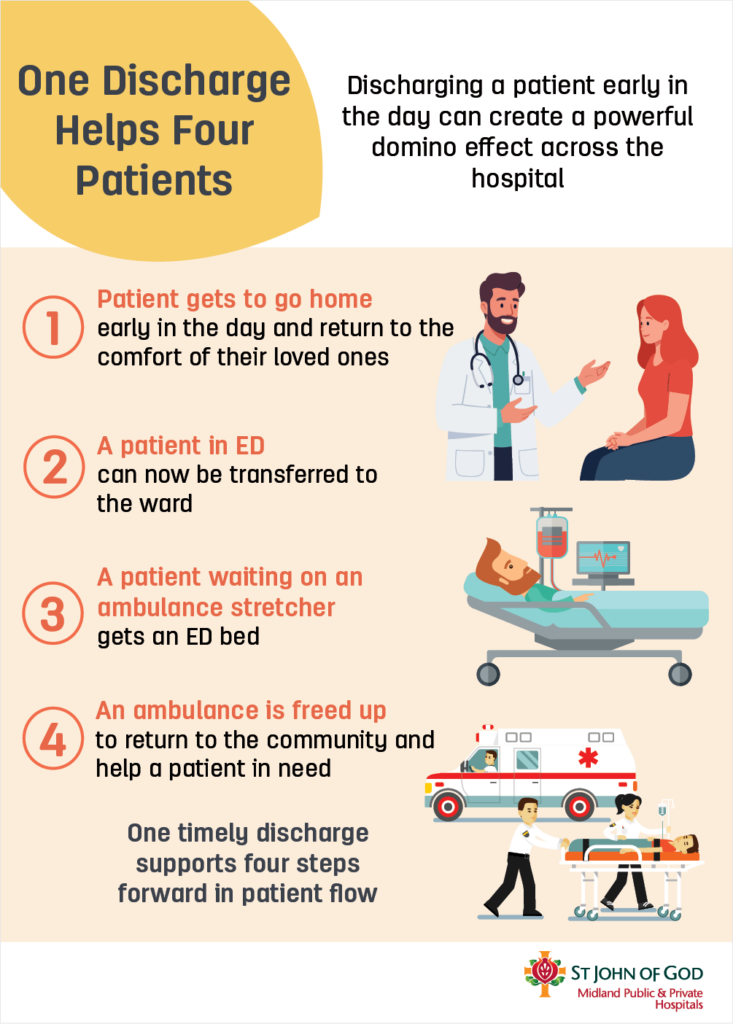
The One Discharge Helps Four Patients initiative at St John of God Midland Public Hospital, developed under the Access to Care program, reinforces the critical role of timely discharge in optimising patient flow. Discharge is one of the few patient‑related variables that caregivers can directly influence, and early discharge generates a 4‑step positive impact across the hospital and broader health system:
- The discharged patient returns home earlier, improving comfort and continuity of care.
- A patient in the Emergency Department (ED) can be transferred to a ward bed.
- A patient waiting on an ambulance stretcher can be moved into the ED.
- An ambulance is released back into the community to respond to new emergencies.
Caregivers are encouraged to reinforce this message through team meetings, huddles and other communication channels to support consistent, organisation‑wide commitment to patient‑flow improvement.